


Democrats are helping push through GOP agenda despite historic blue wave
Democrats are helping push through GOP agenda despite historic blue wave

Jesus Mesa Wed, November 25, 2026 at 1:30 AM UTC
18
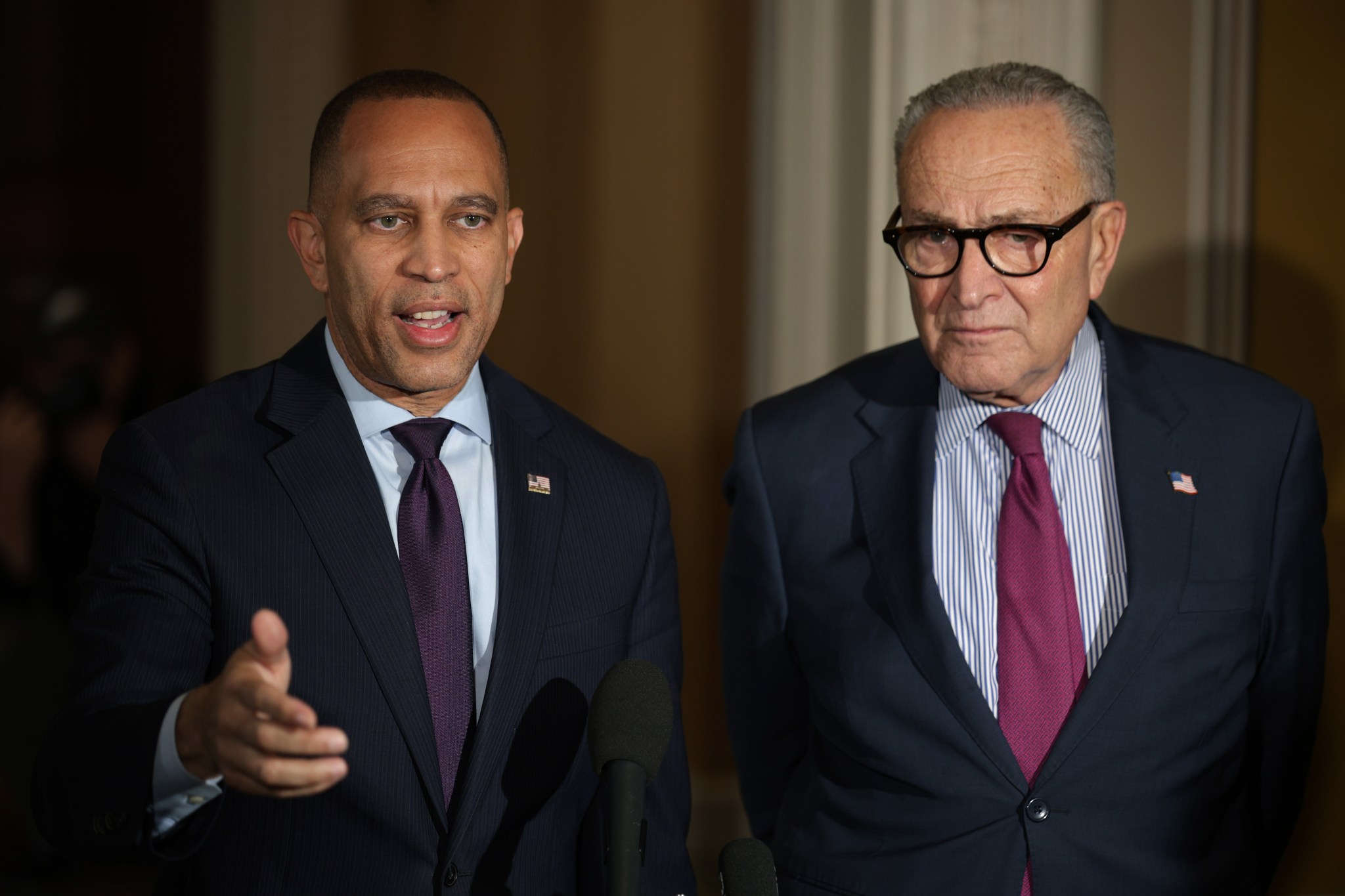
WASHINGTON, DC - OCTOBER 16: U.S. Senate Minority Leader Sen. Chuck Schumer (D-NY) (R) and House Minority Leader Rep. Hakeem Jeffries (D-NY) (L) brief members of the press during a news conference on the government shutdown at the U.S. Capitol on October 16, 2025 in Washington, DC. The Democrat leaders held a news conference to speak on their demands as the government shutdown enters its 16th day. (Photo by Alex Wong/Getty Images)
Three weeks after voters handed Democrats control of both chambers of Congress, the party is helping Republicans push through some of President Donald Trump‘s priorities before the new Congress is sworn in on January 3.
Fifteen members of the Senate Democratic caucus, including Minority Leader Chuck Schumer, voted last week for a permitting overhaul backed by the White House and the oil industry. Several Democratic senators also voted to advance Trump’s judicial nominees, while none objected as Republicans rushed confirmation votes ahead of the Thanksgiving break.
In the House, eleven Democrats missed a vote on an effort to impeach Defense Secretary Pete Hegseth, effectively helping shelve the measure.
Party leaders are also backing away from a fight over funding for the war in Iran ahead of the December 11 government funding deadline.
Democrats picked up at least nine Senate seats and 44 House seats on November 3. Progressive groups and activists on the left say the party is squandering that victory and ignoring what voters asked for. Democrats defending the approach argue that the biggest fights should wait until January, when the party takes control of both chambers and has the votes to act.
Newsweek reached out to the offices of Schumer and House Minority Leader Hakeem Jeffries for comment by email.
Iran War Funding Fight Pushed to January
Maryland Senator Chris Van Hollen, joined by Senators Bernie Sanders, Michael Bennet and Tammy Duckworth, wants any stopgap passed by December 11 to bar money for the war. Van Hollen has said he would not vote for a funding bill that keeps paying for the war. Schumer, whom Van Hollen is challenging for majority leader, has not committed to that.
Committee leaders lean the other way. Connecticut Representative Rosa DeLauro, the top Democrat on the House Appropriations Committee, has argued that Democrats won’t die on that hill in the lame duck, according to The Hill.
“Until we get that additional leverage, I don’t see how everything moves forward until we’re in control,” New York Representative Gregory Meeks, the incoming chair of the House Foreign Affairs Committee, told Semafor.
Jeffries has floated a short-term extension that would push the fight into next year.
Trump Judges Move Faster With Democratic Help
Senate Republicans are racing to confirm Trump’s remaining judicial nominees before Democrats take over the chamber. With 47 seats, Democrats have few tools to block a nominee outright, though they can make each one eat up floor time. They have mostly let that leverage go unused.
On Friday, six Democrats voted to advance Kyle Reardon, a nominee for the District of Alaska: Catherine Cortez Masto and Jacky Rosen of Nevada, John Fetterman of Pennsylvania, Mazie Hirono of Hawaii, Tim Kaine of Virginia and Jeanne Shaheen of New Hampshire.
The votes were stacked by unanimous consent, and no Democrat objected, though any one of them could have dragged the process out for days.
Progressive group Demand Justice answered with a $500,000 ad buy against Schumer, accusing him of “leaving the door open for backroom deals next Congress” for Trump judges.
Josh Orton, president of Demand Justice, compared the Democratic response with the 2024 lame duck, when Senate Republicans worked to slow President Joe Biden’s judicial nominees and keep Democrats in Washington to confirm them.
“If you compare that maximalist effort in 2024 that Republicans used with the current Democratic effort, it’s embarrassing,” Orton told Newsweek.
He said tougher tactics would not guarantee that any nominee gets blocked. They would, though, test whether Senate Majority Leader John Thune can keep enough Republicans in town to wait out the required hours.
Orton argued that every one of Trump’s second-term nominees had passed a “political litmus test” of loyalty to the president. “Not a single [one] of those nominees was willing to say that Donald Trump lost the 2020 election,” he said. None would say the Capitol was attacked on January 6, he added.
“It’s Schumer’s job to object. It’s Schumer’s job not to make deals to speed through these confirmations,” Orton said. In his view, Schumer “is still living in a Senate of a bygone era,” when few people paid attention to judicial nominees and comity between the parties still counted for something.
Schumer has vowed to block Trump’s judicial picks once Democrats control the chamber, and told The the party won’t confirm “crappy nominees.” He has not ruled out backing some of them.
“There is no political, moral, or historical reason that Democrats should be speeding these nominees through, and the fact that some of them are voting for them is grotesque,” Orton said.
Schumer Votes Yes on Trump-Backed Permitting Bill
The Senate passed the Bipartisan American Affordability and Jobs Act, known as BAAJA, 62-33 on Thursday. The bill speeds environmental reviews and federal permits for energy, transmission and industrial projects. The White House and the American Petroleum Institute back it.
Fifteen members of the Democratic caucus voted yes, among them Schumer, Fetterman, Klobuchar, Sheldon Whitehouse of Rhode Island and Martin Heinrich of New Mexico. Most of the caucus voted no.
Oregon Senator Jeff Merkley called it “pretty damn outrageous and offensive” that the bill passed without a public hearing.
“It’s unconscionable that Democrats helped them do it,” Erich Pica, president of the grassroots environmental organization Friends of the Earth, said in a statement shortly after the measure passed.
Joseph Geevarghese, executive director of the progressive group Our Revolution, tied the vote to the midterms. “Rural voters helped Democrats win, and some of those same communities voted down data center projects because they were worried about higher electric bills and pressure on their water supplies,” he said in a statement to Newsweek.
Advertisement
“Then Chuck Schumer led a group of corporate Democrats in voting with Republicans to advance a Trump-backed permitting bill that would make it easier to build pipelines serving data centers,” Geevarghese said. Van Hollen voted against the bill, he noted.
Missing Democrats Spare Hegseth
On November 10, the House voted 211-204 to send Kentucky Republican Thomas Massie’s eight articles of impeachment against Hegseth to the Judiciary Committee, which effectively shelved them.
Every Democrat who voted opposed the referral, but 11 did not vote. Their absences were larger than the margin, though seven Republicans also missed the vote.
Former Speaker Nancy Pelosi of California was among them. Some of the missing Democrats blamed traffic and a police-escorted bus that held them up on the way to the floor.
“Shame on folks who are not here,” California Representative Sydney Kamlager-Dove said.
The defeat put fresh pressure on Jeffries, who called himself a “hard yes” on impeachment. “It’s just the beginning,” Jeffries said afterward.
More than 80 House Democrats Back GOP Retirement Bill
On November 11 the House passed the Retirement Fairness for Charities and Educational Institutions Act, 295-128. Oklahoma Republican Frank Lucas introduced it. Every Republican who voted backed it, along with 83 Democrats.
The bill would let 403(b) plans, the retirement accounts used by teachers, nurses, clergy and nonprofit workers, invest in collective investment trusts.
Most House Democrats voted no. Massachusetts Representative Jim McGovern warned that many 403(b) plans lack protections available to workers enrolled in 401(k) plans.
The Senate version has a Democratic co-lead, Georgia Senator Raphael Warnock, and eight Democratic co-sponsors.
What Is the Strategy?

Supporters of Democratic senatorial candidate James Talarico react to early election results during a midterm election night watch party at Long Center for the Performing Arts in Austin, Texas, on November 3, 2026. (Photo by RONALDO SCHEMIDT / AFP via Getty Images)
Democrats who defend the approach say the party is saving its leverage for January, when it will hold at least 55 Senate seats and a large House majority.
“The risk of a December showdown is that Democrats only have 47 votes and already several prominent Senate Democrats have voiced concern,” Jim Kessler, executive vice president for policy at the center-left think tank Third Way, told Newsweek. “Like Trump’s ill-fated war with Iran, don’t start a fight without an airtight strategy to win. In a few short weeks Democrats will have control of the Senate and votes to spare. Strike then.”
Doug Gordon, a Democratic strategist and co-founder of UpShift Strategies, made a similar point on timing.
“Democrats are right to use their power to try to bring this war to an end. And the best way to do that is when they have full control over Congress and can pass bills to fund all the government except the war,” he told Newsweek. “But trying to do that in lame duck when they don’t yet have control will only mean parts of the government would get shutdown while the war continues.”
Geevarghese disagreed with that timeline. “The gavels change what Democrats can pass. They don’t change what Democrats can refuse to help pass,” he said. “Voters shouldn’t have to wait until January to see Democrats act like an opposition party.”
He pointed to talk among some centrists, including Virginia Senator Mark Warner and Connecticut Representative Jim Himes, about renewing warrantless surveillance powers before the new Congress takes office. “If there’s time to do that now, there’s time to stand up to Trump now,” Geevarghese said.
Some of the votes also reflect what Democrats themselves want. Whitehouse and Heinrich helped write the permitting bill, and Warnock co-leads the retirement bill in the Senate.
On judges, the deals follow Senate custom. In 2018, Schumer agreed to fast-track 15 Trump judges so vulnerable incumbents could go home and campaign.
‘Failed Leadership’
Orton rejected that reasoning. He called the approach “evidence of failed leadership” that puts “skipping work and going home for the Thanksgiving recess” ahead of the moral objections to the nominees.
“In some ways the lack of fight on judicial nominees is how Democratic leadership operates when it thinks no one is looking,” he said. “Well, they need to get the message that everyone is looking.”
Progressive activists read the lame duck as an early test of whether the new majority will fight, and the votes are landing right before Senate Democrats pick their leader on December 1. Van Hollen has made the Iran war central to his challenge to Schumer.
“Voters didn’t give Democrats a mandate. They gave them a directive: Stand up to Trump, take on corporate power, and fight for working people,” Geevarghese said.
Our Revolution is organizing to elect Van Hollen as leader and plans to track how members voted in the lame duck. “We’ll make sure voters know who showed up, who helped Republicans move their agenda, and who stood up for the people who delivered this majority,” he said. “We’ll keep organizing in primaries, too.”
For January, Orton said the midterm mandate was “to hold the most powerful, greedy forces in our country accountable,” from administration officials who use the government to enrich themselves to health insurance companies and a handful of tech billionaires.
“If they want to show voters that they meant what they said when they were running to take on those powerful interests, then they damn well better show that fight when they take office,” Orton said.
Newsweek’s reporters and editors used Martyn, our AI assistant, to produce this story. Learn more about Martyn here. Contact Newsweek editors on this story: Jason Lemon and Gray R. Thomas
Source: “AOL Breaking”
